
Clarity Forces Commitment
Maybe the simple idea is the right one?

Last week I came across one of my dad’s ads.
It was his 1962 Bell Telephone System ad, which AIGA named among the 50 best ads of the year. A black-and-white photograph. Rain streaking down a windowpane, everything slightly blurred and moody. Eight words:
It’s a perfect day to shop by phone.
That’s it.
No taglines or visual stack. No elaborate teasers or marketing buzz. Just a feeling you get when you look at it, and the confidence to let the viewer complete the thought.
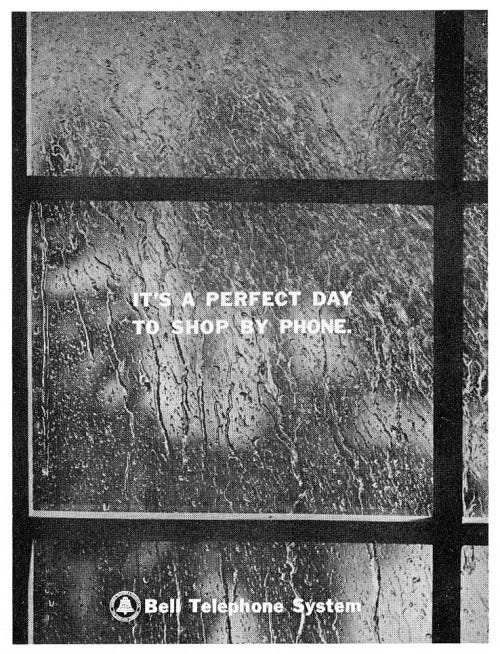
What I love about that ad is how much it conveys without saying anything directly. It works because it asks the image, and the viewer, to carry meaning together... It’s an emotional space before it’s a literal one. The copy doesn’t explain the benefit of shopping by phone. It doesn’t try to pitch a deal. It doesn’t promise anything - It trusts you to understand it. It trusts the mood and those eight words to do the work. I found it at the right time.
I’ve been thinking ideas for a 2026 campaign around a work project that’s somewhat complex. As someone who handles both strategic communications and marketing, I’m always navigating multiple audiences, layered messages, and competing priorities. Every deliverable is also expected to accomplish multiple objectives at once - raise awareness, differentiate, drive engagement, convert, build trust, educate, and support organizational goals. When you’re trying to do all of that without a team, there’s a natural tendency (at least for me) to overthink, run the arguments in my own head, and layer on more: more context, more nuance, more justification, more proof. I’m also just naturally drawn to complexity. Concepts, people, problems that need solutions…I enjoy mapping patterns, peeling back the layers and making discoveries that need a willing audience. Maybe sometimes, in my work, I equate complexity with competence. If I’ve covered every angle and justified every choice, I don’t have to risk being wrong or disappointing someone.
Marketing often rewards complexity. Better decks, more frameworks, added nuance, theme variations. The more complex it is, the more legitimate it must be.
I’ve never heard my dad talk about messaging pillars. And I think he was a pretty damn good art director and copywriter.
Simplicity, I would argue, is an expression of courage.
Clarity forces commitment.
Sometimes, in trying to say everything, we risk saying nothing that really lands.
Anyway, I keep coming back to an idea that feels almost too simple. The kind you have right before falling asleep, and dismiss the next morning because it came too easily. Then I found my dad’s ad. And suddenly the “too simple” idea I’d been questioning didn’t feel off anymore.
My dad spent his career in an era when advertising relied on clarity, restraint, and a kind of quiet confidence. Those mid-century ads weren’t simple because people lacked imagination, they were simple because the designers respected the audience. It was the idea that less can actually make people think more.
Maybe restraint isn’t the absence of ideas, it’s the discipline of choosing the right ideas and taking the chance of letting them stand on their own. A pared-down, two-tone visual and a single thought - I really don’t want to go outside in this weather, and you’ve just given me permission to stay in - can be far more memorable than something overloaded with choices.
So now, when I look at the simple campaign idea I’ve been debating, I see it differently. I’m allowing myself to feel okay about how simple the idea is. That a good context, a few words, and the right emotional anchor can carry more than a crowd of competing concepts.
It may not be the best approach for every campaign, but it’s right for this one.
I’m choosing not to over-explain. Though one could argue that this entire essay is a slightly roundabout way of doing exactly that. (I can be very sneaky, you know.) Still, it’s an attempt to resist adding “just one more thing,” and to trust that an idea can stand on its own without padding. As someone who tries to account for every angle, that’s not easy, but I’m willing to take the risk.